
Skip to the content
Filara Biomedlogo darklogo light
  • Home
  • Products
  • About
  • Suppliers
  • Contact
  • Romanian
  • Romanian
Search
Filara Biomed
  • Romanian
  • Home
  • Products
  • About
  • Suppliers
  • Contact
  • Romanian
HomeShopKits and reagentsRNA Extraction KitsISOLATE II RNA Mini Kit
ISOLATE II RNA Mini Kit
ISOLATE II RNA Mini Kit - Image 1

ISOLATE II RNA Mini Kit

Highly efficient purification of total RNA by combining the stringency of guanidinium thiocyanate lysis with the speed and purity of silica-membrane column purification.

Category:RNA Extraction Kits Brand: Bioline
  • Description
  • Specifications
  • Downloads

Description

Cat. No. Size
BIO-52071 10 Preps
BIO-52072 50 Preps
BIO-52073 250 Preps
Product Highlights
  • Fast – simple extraction of high purity total RNA from six samples, ideal for use in all applications, in as little as 30 minutes
  • High-performance – recovery of consistently high quality RNA from a wide variety of animal, bacterial and plant cells and tissues and cell-free samples
  • Efficient – optimized lysis conditions and column matrix for recovery of up to 70 mg of high purity RNA from each sample
  • Convenient – includes all necessary components, including filters (shredders) and DNase I
  • Safe – no hazardous phenol/chloroform extraction, CsCl centrifugation, LiCl or alcohol precipitation

The ISOLATE II RNA Mini Kit provides a simple, efficient column-based method for the isolation of total RNA from a wide variety of starting materials, without the need for hazardous reagents such as phenol.

By combining the stringency of guanidinium-thiocyanate lysis with the speed and ease-of-use of silica-membrane purification, the ISOLATE II RNA Mini Kit provides a fast method for the purification of high-quality total RNA from animal and plant cells and tissues as well as cultured cells, bacterial cells, yeast, biological fluids and cell-free samples.

Biological samples which are sometimes difficult to process i.e. mouse tissue (liver, brain), various tumor cell lines, Streptococcus and Actinobacillus pleuropneumoniae, will yield high-quality RNA with the ISOLATE II RNA Mini Kit.

The online product manual has protocols for purifying total RNA from cultured cells, tissues, yeast, bacteria, biological liquids, paraffin embedded tissue and RNAlater® treated samples. There is also a protocol for a convenient on-column DNase treatment, using RNase-free DNase I that is supplied with the kit, for applications that are sensitive to very small amounts of DNA.

The ISOLATE II RNA Mini Kit has been designed to deliver optimal performance in RT-qPCR in conjunction with either the SensiFAST cDNA Synthesis Kit and SensiFAST Real-Time PCR Kits, or the SensiFAST One-Step Real-Time RT-PCR Kits. Additionally, the ISOLATE II RNA Mini Kit can be used to purify samples for PCR and RT-PCR amplification using the Tetro cDNA Synthesis Kit and any enzyme from the Meridian PCR portfolio, including MyTaq DNA Polymerase.

Applications
  • RT-qPCR
  • End-point RT-PCR
  • Northern, dot and slot blotting
  • Array analysis
  • Poly A+ RNA selection
  • RNA-Seq

Specifications

Components

Reagent

10 Preps

50 Preps

250 Preps

ISOLATE II Filters

10

50

250

ISOLATE II RNA Mini Columns & Collection Tubes

10

50

250

Collection Tubes (2 mL)

30

150

750

Collection Tubes (1.5 mL)

10

50

250

Lysis Buffer RLY

10 mL

25 mL

125 mL

Wash Buffer RW1

15 mL

15 mL

80 mL

Wash Buffer RW2

6 mL

12 mL

3 x 25 mL

Membrane Desalting Buffer MEM

10 mL

25 mL

125 mL

Reaction Buffer for DNase I RDN

7 mL

7 mL

30 mL

DNase, RNase-free (lyophilized)

1 Vial

1 Vial

Resources

Documents

ISOLATE II RNA Mini Kit - Product Manual

ISOLATE II RNA Mini Kit - MSDS

ISOLATE II RNA Mini Kit - Protocol

Latest Certification of Analysis (COAs)
BIO-52073_IS510-B126530

Reviews

"I used the ISOLATE II RNA mini kit to isolate RNA from a range of murine ... "

Cavan Bennett, Walter and Eliza Hall Institue of Medical Research, Melbourne, Australia

"We have been using Meridian products (especially the Isolate II RNA mini Kit, ... "

Kuan Won, Mater Research Institute, Brisbane, Australia

"I recently used the ISOLATE II RNA Mini kit. I had some cultured cells which ... "

Sharon Pok, Australian National University Medical School, Garran, Australia

"We have been utilizing ISOLATE II RNA Mini Kit from Meridian and have found ... "

Aparna Jayachandran, GMRF-UQ, Brisbane, Australia

FAQs

Can I use columns or solutions from one kit in another one?

The columns supplied with the ISOLATE II kits may appear similar, but each type has been optimized to work within the buffer system supplied with the corresponding kit. The swapping of columns (or buffers) between kits may lead to no recovery of nucleic acid whatsoever, or at the very least severely impaired purification.

Is it possible to interrupt the DNA or RNA extraction protocols?

Interruption of the DNA/RNA extraction process is possible after the sample lysis only. It is possible to homogenize and lyse the samples and to store them in the freezer until use for RNA extraction. RNA clean up with a column cannot be interrupted and we recommend to avoid delays during the column purification process. If a delay is unavoidable the columns should be stored on ice.

Our extracted samples are showing a high 230nm reading, resulting in a bad 260/230 ratio. What is the reason for that and what does it mean in respect to RNA quality?

An increase of A230 values may be caused by different substances, like carbohydrates, peptides and phenol. A bad A230/A260 ratio in RNA samples is mostly due to a contamination with guanidinium thiocyanate which is present in several reagents used for RNA extraction, for instance in the lysis buffer. In contrast to a bad A280/A260 ratio it does not automatically reflect a bad RNA quality. Currently there is no consensus about a lower limit of this ratio and mostly a carry-over of guanidinium thiocyanate does not affect the reliability of downstream applications. Nevertheless, an extra washing step with RW2 would be helpful to avoid this problem. And it would be helpful to pipet the flow-through out of the collection tube, instead of pouring it off.


Which is the recommended kit for processing of soil samples or hard to lyse bacteria?

It is possible to use the ISOLATE II Plant DNA and RNA kits. The optimized lysis of these kits may be also useful for processing difficult to lyse bacteria and fungi in soil samples

What do I need to consider for the clean-up of large fragments?

For the optimal recovery of large RNA/DNA fragments it is necessary to optimize the elution step. To increase the recovery rate it would be helpful to use a larger volume for elution, incubate the column with the elution buffer prior to centrifugation and use repeated elution steps. To avoid excessive dilution it may be helpful to reapply the eluted fraction again.


What is the recommended kit or protocol for RNA extraction from tissues with high lipid content like adipose or brain tissue?

Several possibilities exist. If you are using our column based extraction kit like the ISOLATE II RNA Mini kit it would be necessary to decrease the sample amount of such samples or to increase the amount of the lysis buffer RLY to prevent clogging of the columns. Another possibility would be a pre-extraction with TRIsure (BIO-38032) and to clean up the RNA containing aqueous phase with the column based ISOLATE II RNA kits. You should follow the TRIsure protocol up to the phase separation step. Then mix the aqueous phase with a volume of ethanol and load it onto the column. From there you should proceed with the regular ISOLATE II RNA Mini kit protocol.

I want to process samples treated with RNAlater, what do I have to consider?

These samples are treated as usual, just remove the RNAlater solution.

Can I use a gel to check the quality of RNA samples isolated using the ISOLATE II RNA kits?

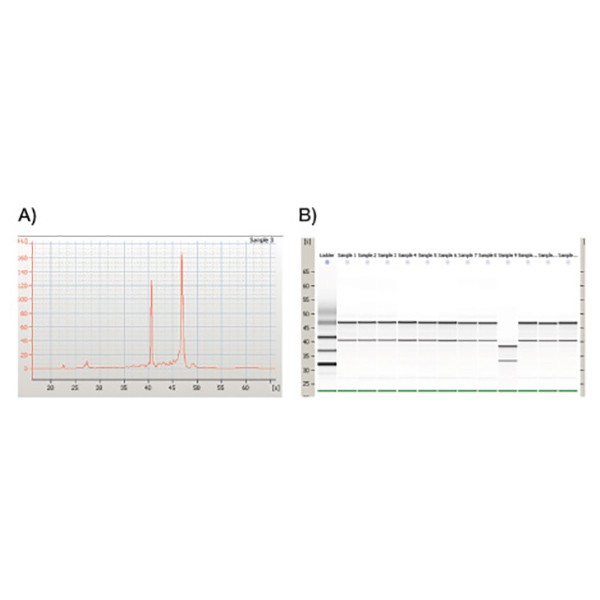
Agarose gel analysis of RNA samples can be both valuable and misleading. The pattern of bands on the gel can not only be indicative of the quality of the sample, but equally it can also only indicate that the gel tank, buffer or agarose is contaminated with RNase. A safer measure is to use a Bioanalyzer and look at the RIN value (RNA Integrity Number), which should be as close to 10 as possible, indicating that the RNA is not degraded. A spectrophotometer (ideally a microfluidic one) can also be used to determine the ratio of A260 to A280 for purity determination.

All these methods give an idea of the quality of total RNA which tends to be dominated with rRNA and tRNA. It is not uncommon for an agarose gel to show an abundance of 18S and 23S rRNA but on analysis for there to be little of the transcript of interest. Ideally RNA quality control should include an assessment of the presence of common transcripts (from reference genes, such as GAPDH) using RT-PCR or RT-qPCR.

If the yield of RNA is low, it is best to first check that all the solutions used and the equipment employed is largely free of RNase. Solutions should be prepared with the highest quality reagents available, preferably ones that have a certificate of analysis to show that they are free of DNase and RNase. If there is confidence that RNase contamination is at a minimum, then it may be worth ensuring that the sample is properly homogenised before lysis and to check a sample of the lysed material under a light microscope to ensure that all the cells are disrupted.

RNA samples that have been contaminated with RNase (either during processing or those that have been sent from another lab) can be purified using the ISOLATE II RNA Micro Kit.


Downloads

ISOLATE II RNA Mini Kit - Product Manual

ISOLATE II RNA Mini Kit - MSDS

ISOLATE II RNA Mini Kit - Protocol

Related products

  • RiboSafe RNase Inhibitor
    RNA Extraction Kits

    RiboSafe RNase Inhibitor

    Read more
  • ISOLATE II RNA Micro Kit
    RNA Extraction Kits

    ISOLATE II RNA Micro Kit

    Read more
  • ISOLATE II RNA Plant Kit
    RNA Extraction Kits

    ISOLATE II RNA Plant Kit

    Read more

Subscribe to our newsletter

    Company

    • Products
    • About
    • Suppliers
    • Contact

    Legal

    • Privacy policy

    © 2025 Filara Biomed. All Rights Reserved.

    Back to top Drag
    w
